Water gives Wrocław much of its character and complicates some apparently simple journeys. A room can look close to a faculty until a bridge and a tram route enter the calculation. For international students, this is part of learning the city: choosing among universities, finding the right bank of the river and building a week that leaves time for the course itself.
The teaching sites behind the city name
The university area around Grunwaldzki Square is one possible centre of student life; buildings elsewhere in Wrocław create other routines. The Market Square is a useful meeting point, while a timetable may revolve around laboratories, libraries and teaching rooms away from it. Start with those destinations when comparing accommodation. Geography becomes particularly noticeable when a busy week leaves little spare time between classes.
Three starting points for an academic shortlist
Wrocław University of Science and Technology, the University of Wrocław and Wrocław University of Economics and Business offer different academic settings. Read the programme-level information for the institution that interests you. A technical project, a humanities seminar and an economics course require different facilities and methods, even when similar claims about international study appear on their websites. Confirm the degree level and complete teaching language before comparing the details.
Following the rivers through daily life
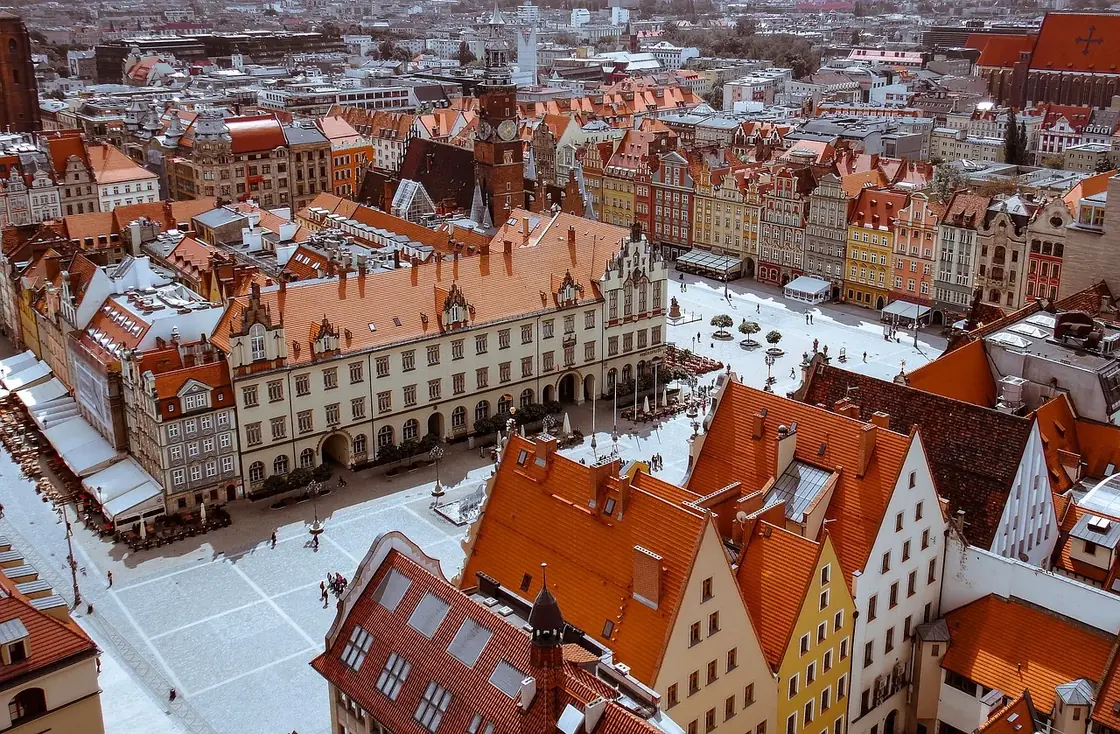
The historic Market Square is the city's most recognisable public space, but the everyday student geography may centre on bridges and tram connections around the university area. Ostrów Tumski offers quiet streets, while Nadodrze has a different urban texture of workshops, cafes and tenements. Wrocław's numerous waterways are beautiful and also shape journeys: a direct line is often more useful than a seemingly nearby room across a bridge. Walking a prospective route is better than judging it from a property advertisement.
The resources your subject needs
Compare three practical things before choosing Wrocław: the faculty address, housing options on a realistic transport route and access to laboratories or libraries outside normal lecture hours. An applicant planning engineering studies should look carefully at the balance of mathematics, technical laboratories and design projects. A humanities candidate should examine seminar choices, archives and language requirements. Both should ask the international office about orientation, recognition of qualifications and who helps when official documents need clarification.
A course name leaves questions open
Suppose a student shortlists two programmes called 'Management' or 'Computer Science' in different Wrocław institutions. Their modules might emphasise theoretical analysis, industry practice or interdisciplinary teamwork. Read course syllabuses semester by semester; note compulsory internships and the language used during practical components. The best decision will combine academic fit with manageable daily life rather than a city-wide reputation for being student-friendly.
Test the bridge on your route
Ostrów Tumski, Nadodrze and the historic centre offer different settings for a free afternoon. For housing, put the faculty first and trace a weekday journey from the address being offered. Include walking to the stop, crossing the river and changing lines. Compare the evening service as well as the morning one.
Then read the costs. A room's rent is only part of the monthly payment if utilities, internet or building charges sit outside it. Ask what happens to the bill during the heating season and obtain clear terms for the deposit. Convenience and the full cost need to be considered together.
Find out how a course is taught
For an engineering applicant, laboratory access and the sequence of design work are particularly revealing. Humanities students may want to ask about seminar groups, research materials and language expectations. The useful question is what a student actually does in the first year, with which equipment or sources, and under what supervision.
The international office can help identify the administrative route, but a department can answer these subject-specific questions more directly. Keep the current study plan alongside the admissions requirements. If practical teaching uses an additional language, establish that before treating the English label as the full answer.
Build a routine with room for the city
A city becomes familiar through repeated journeys. A walk by the river, a regular society meeting or a study session with classmates can make Wrocław feel smaller without reducing it to a collection of landmarks. Ask about orientation and activities open to full-degree international students.
The practical preparation is modest but useful: locate the faculty office, find the correct stop for the return trip and identify a place to work between classes. Wrocław offers plenty of reasons to take a longer route home. A well-chosen room and a manageable timetable give you more opportunities to do so when you want to, rather than because the bridge on the map was further away than it looked.
Make room for a project outside the syllabus
Wrocław can appeal to applicants who want their subject to lead into practical work. That ambition deserves a closer question than whether a city has a technology sector. Look for the route from a first-year class to a student project, and ask what knowledge is needed before newcomers can contribute.
For computer science, that might mean a team that builds and maintains something over a semester. For engineering, it might involve design, testing and documenting why a prototype failed. Participation conditions, supervision and the language used by the team all matter. A photograph of impressive equipment cannot establish whether it is available to students on your particular course.
Keep extracurricular work in proportion. A useful project should deepen the degree rather than crowd out its foundations. Ask current students when they found time to join, what support they received and what they would learn first if starting again. Their answers can give your first term a realistic shape. They may also reveal that the most valuable opportunity is smaller and less glamorous than the one featured in a promotional video.